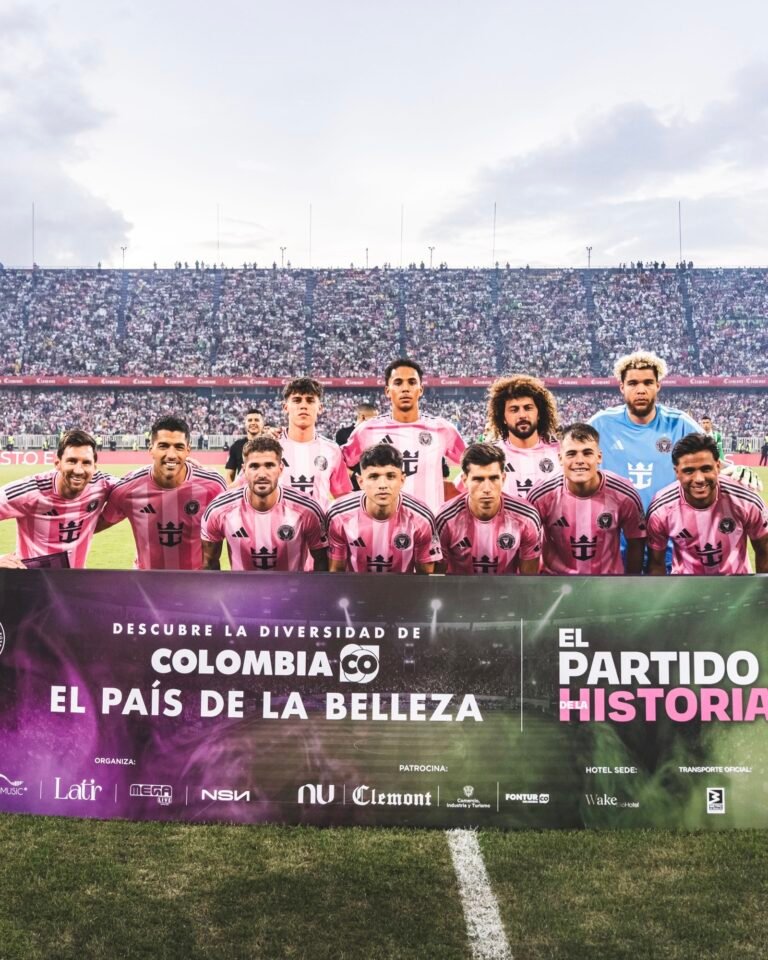
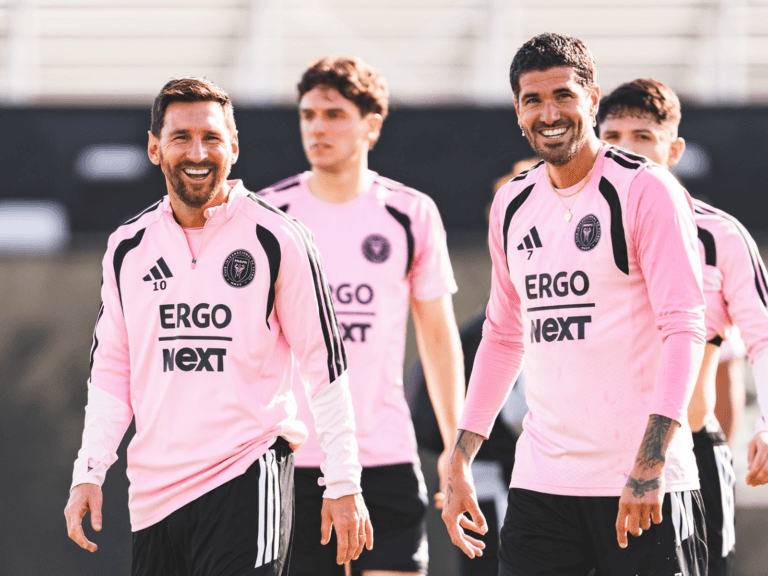
Photo via Inter Miami CF on X
Inter Miami’s 2026 midfield plan is no longer a mystery — and it’s shaping up to be one of the biggest transitions of the Messi era. With Sergio Busquets announcing his retirement after lifting the MLS Cup, the club has shifted its focus toward building a younger, more dynamic, and more balanced midfield core.
This is not a reset. It’s an evolution — one centered around energy, defensive structure, vertical progression, and maintaining control in possession. With the arrivals and development of Rodrigo De Paul, Yannick Bright, Telasco Segovia, Baltasar Rodríguez, and now David Ayala, Inter Miami’s blueprint for 2026 is becoming clear.
Below is a full breakdown of every key piece of Miami’s midfield puzzle.
David Ayala: The Signing That Signals Miami’s Intent
Among Miami’s new midfield pieces, none has generated more excitement than David Ayala.
The 23-year-old arrives from the Portland Timbers after a standout 2025 campaign, where he quietly established himself as one of the most complete two-way midfielders in MLS. Ayala isn’t flashy. He isn’t a highlight merchant. But he’s relentless, positionally disciplined, tactically intelligent, and built for modern MLS demands.
Key 2025 MLS Numbers (Portland Timbers)
• 33 appearances
• 2 goals, 1 assist
• 88 tackles (2nd in MLS)
• 56 tackles won (2nd)
• 43 dribblers tackled (4th)
• 48 interceptions (7th)
• 201 passes into the final third (8th)
• 2,188 touches
• 1,634 successful passes
• 87.6% pass accuracy
• 227 successful long passes
• 76.6% long-pass accuracy
• 193 progressive passes
• 49 shot-creating actions
Ayala brings exactly what Miami lacked at times during the 2025 season: defensive bite and controlled distribution. He is not a Busquets clone, but he is the closest stylistic successor Miami could realistically acquire — someone who stabilizes structure while elevating the tempo of play.
Ayala is expected to become the foundational pivot in Mascherano’s system.
Rodrigo De Paul: The Engine of Miami’s Midfield
Rodrigo De Paul’s arrival last season changed the personality of Miami’s midfield. After leaving Atlético Madrid to reunite with Lionel Messi, De Paul quickly became both an emotional leader and a tactical reference point.
His form dipped briefly during the midseason stretch, but when Miami needed him most, he delivered — including a crucial goal in the MLS Cup Final and a key pre-assist to Tadeo Allende earlier in the playoffs.
2025 Key Metrics
• 17 appearances
• 4 assists
• 2.5 xA
• 5.1 ball recoveries per game
• 3.9 total duels won per game (52%)
• 3.8 ground duels won per game (53%)
Nicknamed El Motorcito for a reason, De Paul provides defensive coverage, pressing intensity, and late-arriving attacking runs. His chemistry with Messi makes him indispensable, and his leadership will be even more important in a Busquets-less midfield.
Yannick Bright: The Underrated Enforcer
Yannick Bright might be the most overlooked player in Miami’s midfield group. His 2025 season proved he can be trusted in big moments and difficult stretches.
Bright offered depth, physical presence, and tactical discipline when Miami needed fresh legs or protection. Despite limited starts due to Busquets’ dominance, he still played an important role.
2025 Contribution
• 32 matches, 16 starts
• 1 goal, 1 assist
• 1.9 tackles per game
• 2.9 recoveries per game
• 1.0 clearances per game
• 3.7 duels won per game (54%)
• 3.3 ground duels won per game (56%)
With Busquets retiring and Bright signing a contract extension, his importance will rise significantly in 2026. Expect more starts and increased responsibility, especially in physically demanding matches.
Telasco Segovia: Creativity With Uncertain Future
Signed as a U22 Initiative player, Telasco Segovia delivered one of the most memorable breakout seasons for Miami — particularly in the first half of 2025.
2025 Output
• 37 appearances (19 starts)
• 9 goals, 6 assists
• 3.1 xG
• 90% pass accuracy
• 25 key passes
Segovia’s ability to create goals from unusual situations made him one of Miami’s most dangerous midfielders early in the year. But as the season progressed and tactical needs shifted, his minutes declined, sparking speculation about interest from European clubs.
Miami want to keep him, but roster rules may complicate his future.s part of the plan, but his status could change quickly depending on transfer offers and roster constraints.
Baltasar Rodríguez: The Complicated Decision
Baltasar Rodríguez showed flashes of elite potential, including a Goal of the Season contender against D.C. United. His ability to drift between lines and create overloads makes him an exciting long-term prospect.
But inconsistency and the physical demands of MLS remain concerns.
2025 Snapshot
• 20 appearances (12 starts)
• 3 goals, 3 assists
• 50 minutes per match
• 3.3 duels won per game (43%)
• 3.1 ground duels won per game (44%)
He started the MLS Cup Final but was subbed at halftime due to midfield imbalance, with Segovia coming on to stabilize the match. Despite Miami initially declining his purchase option, reports now suggest the club may attempt to re-sign him for approximately $4–4.5 million.
His return depends heavily on MLS roster constraints.
The 2026 Midfield Puzzle: How MLS Roster Rules Shape Everything
Inter Miami’s midfield decisions cannot be separated from MLS roster rules.
If Rodríguez returns as a U22 Initiative signing, Miami would exceed the allowable number of U22 slots. That scenario could force them to sell Segovia or Avilés, or limit their ability to add a future DP. Ideally, Miami might want to keep both Segovia and Rodríguez, but that is only possible if Rodríguez’s deal is structured outside the U22 Initiative.
This matters because Mascherano needs more than just a fixed starting trio. The 2025 season showed how thin the margins can be during busy stretches. Injuries, travel, and constant midweek matches proved that Miami need multiple midfield profiles: Ayala’s control, De Paul’s intensity, Bright’s physicality, Segovia’s creativity, and Rodríguez’s vertical passing.
To stay competitive across MLS, Leagues Cup, and international tournaments, Mascherano must have at least five or six midfielders he can trust, not just three locked-in starters.
Final Take: A Midfield Built to Compete
Inter Miami’s midfield for 2026 is not a Busquets replacement project. It is a complete evolution. Ayala brings structure and control. De Paul adds intensity and leadership. Bright supplies defensive insurance. Segovia contributes unpredictability and creativity. Rodríguez offers technical quality and vertical play.
Miami cannot afford to sell Segovia and replace him with Rodríguez. They are very different profiles, and Mascherano needs both of them to manage the demands of a long season.
Another name to watch is David Ruiz, who missed most of 2025 with injuries and made only four appearances. His return adds another layer of intrigue: will Mascherano reintegrate him as a rotational piece, or will his development follow a path similar to Benjamin Cremaschi’s, where competition and tactical fit determine minutes?
If Miami navigate the roster rules correctly, this midfield could become one of the most balanced and competitive units in MLS — and the foundation of the next chapter of the Messi era.